
Put a round table and a curved sofa in a room, and most people will tell you it feels softer or more welcoming, even if they can’t say why. Swap them for square tables and boxy chairs and the words change: neat, sharp, a bit formal.
We wanted to know whether there’s more to that than taste, so we went looking at the research. Scientists have been testing this reaction for about twenty years, and what they’ve found is useful for anyone planning a home or a venue. Here’s how we understand it, where we think it stops, and how we put it to work.
Our eyes like curves
The study we always come back to is a simple one. In 2006, researchers Moshe Bar and Maital Neta showed people pairs of objects, some everyday items and some abstract patterns. Each pair was identical except for one detail: one version had rounded edges, the other had sharp corners. People liked the rounded versions more, even when they saw them for only a split second (Bar and Neta, 2006).
Their explanation is one we find easy to picture. Sharp points can hurt us, so the brain may treat them as a tiny warning sign before we’ve even thought about it. When the same researchers scanned people’s brains, sharp shapes caused more activity in the amygdala, the part of the brain that handles fear (Bar and Neta, 2007).
We should be honest that scientists don’t all agree on that “why”. A 2016 review of the research sets out several competing explanations and says there’s no single answer yet (Gómez-Puerto, Munar and Nadal, 2016). What reassures us is that the preference itself keeps showing up, study after study.
It works for furniture and whole rooms too
For us, this is where the research gets really useful, because it moves from objects on a screen to the rooms we actually design. Two interior design researchers, Sibel Dazkir and Marilyn Read, showed people the same room furnished two ways: once with rounded furniture and once with straight-edged pieces. They kept the images black and white so colour couldn’t sway anyone. People found the rooms with curved furniture more pleasant and more inviting, and described the rounded pieces as more comfortable and calming (Dazkir and Read, 2012).
A year later, a team led by Oshin Vartanian looked at brain activity while people viewed photos of real interiors. People were more likely to call the curved rooms beautiful, and those rooms lit up an area of the brain linked to emotion and reward. The detail we find most interesting is that the shape didn’t change whether people wanted to walk in or walk out (Vartanian et al., 2013). So curves made a room feel more beautiful, and straight rooms didn’t feel unwelcoming.
How we read it (and why we don’t make everything round)
We find this research useful, but we keep it in proportion. These studies asked people, mostly students, to rate pictures. Nobody lived in those rooms, cooked in them or worked in them for a week. Liking a shape on a screen and enjoying a space every day are related, but they aren’t the same thing.
We also know straight lines do jobs curves can’t. A kitchen run, a wall of storage, a desk or a long dining table works better with straight edges: they line up, fit against walls and make a room feel ordered. Taste, culture and the mood you want in a room all matter too.
So we use it as a balance. Curves help a space feel softer and more inviting, and straight lines give it structure. Most rooms need both, in different amounts depending on what the room is for.
Where we like to use curves
These are the places where we find curves make the biggest difference, with a few examples from our own projects at Paz Studio.
Where people sit together
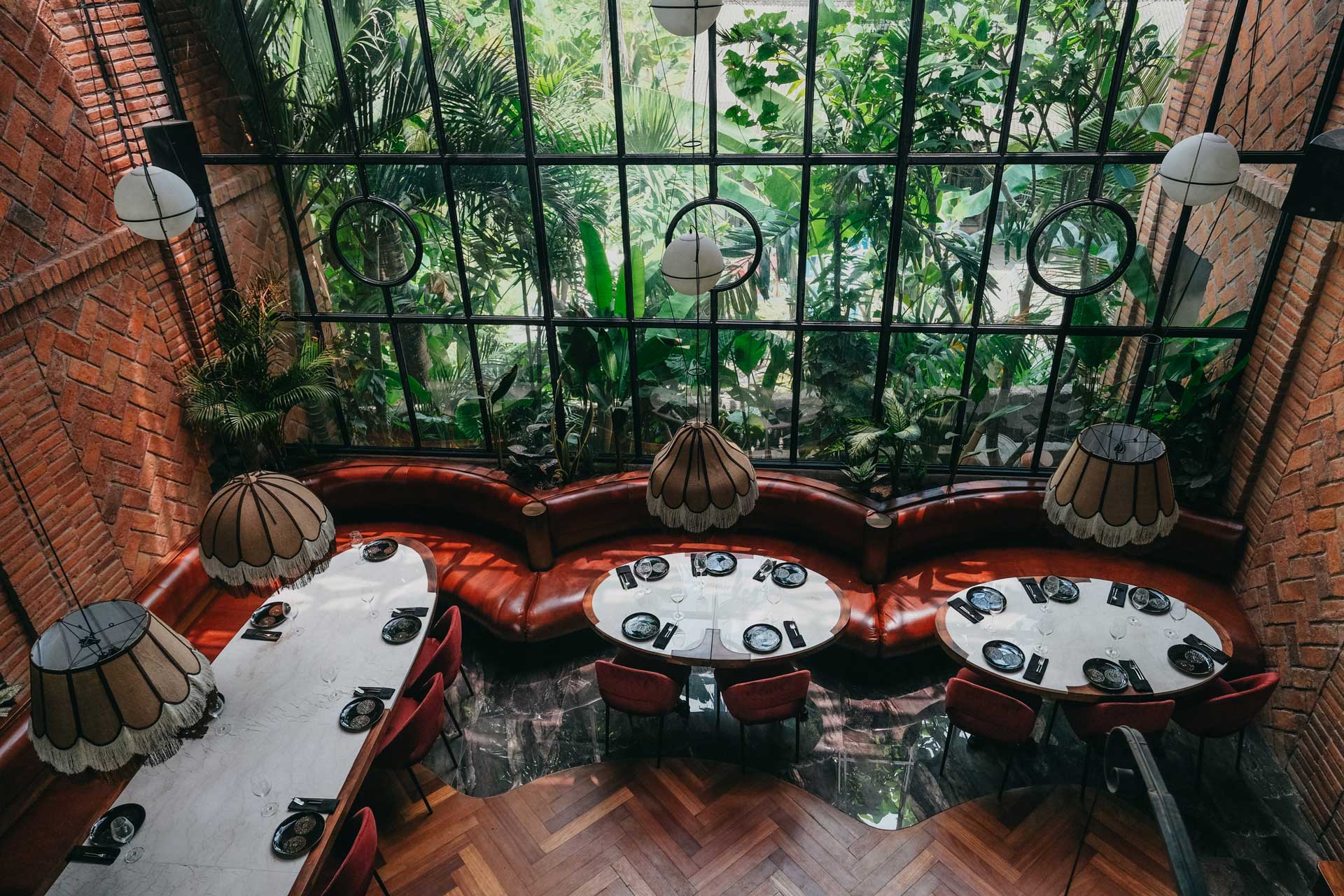
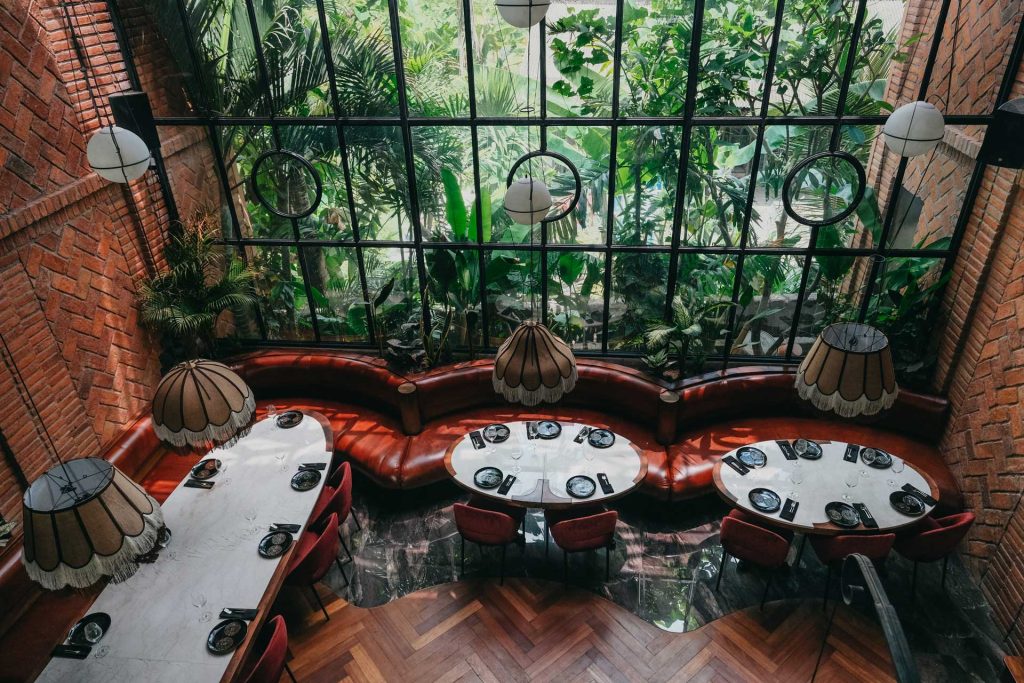
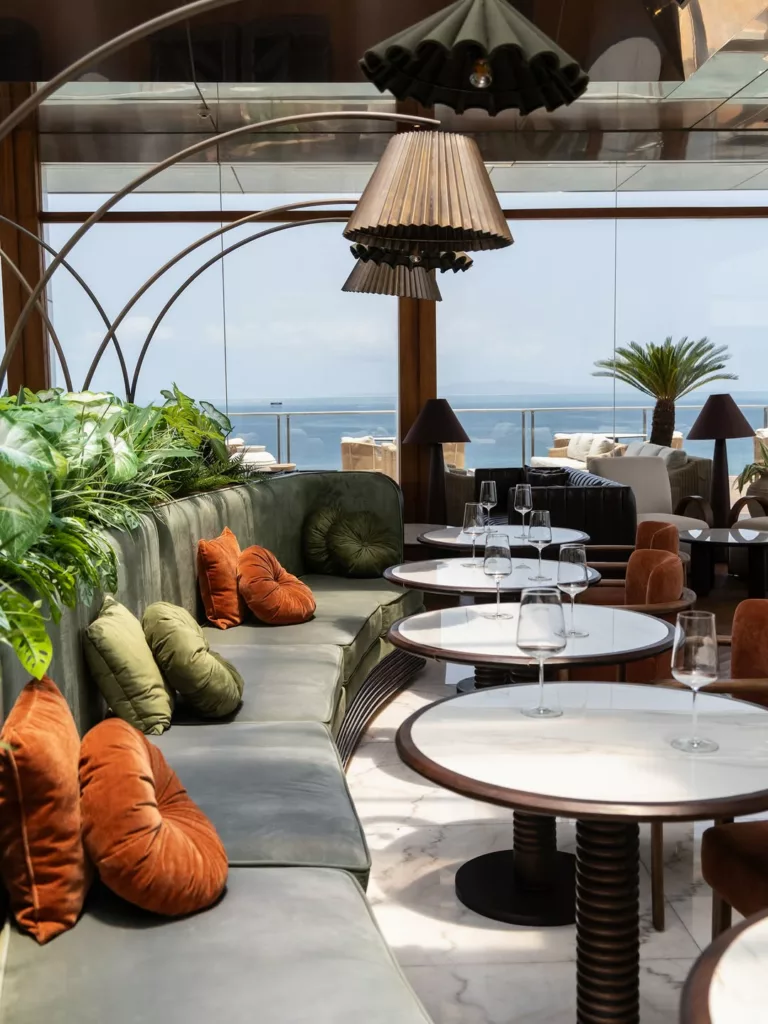
We like round tables and curved banquettes wherever people gather. They have no head of the table, and they angle people slightly towards each other, so conversation comes more easily. In a restaurant they also guide how people move through the room. At Santanera, we wrapped the dining room in curved leather banquettes under a double-height glass wall.
Doorways and windows
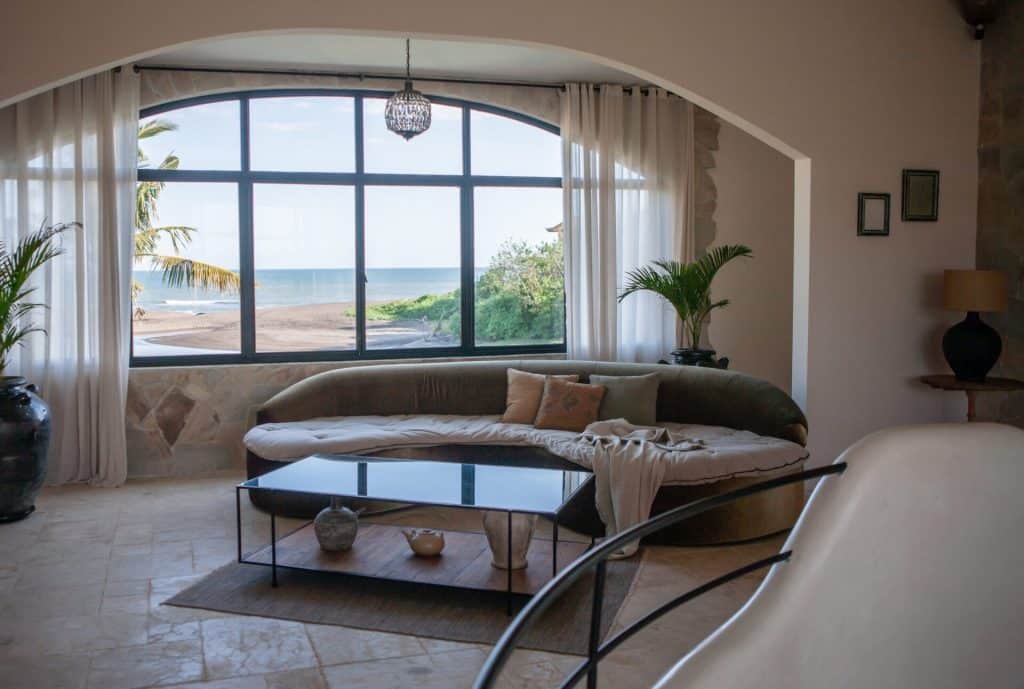
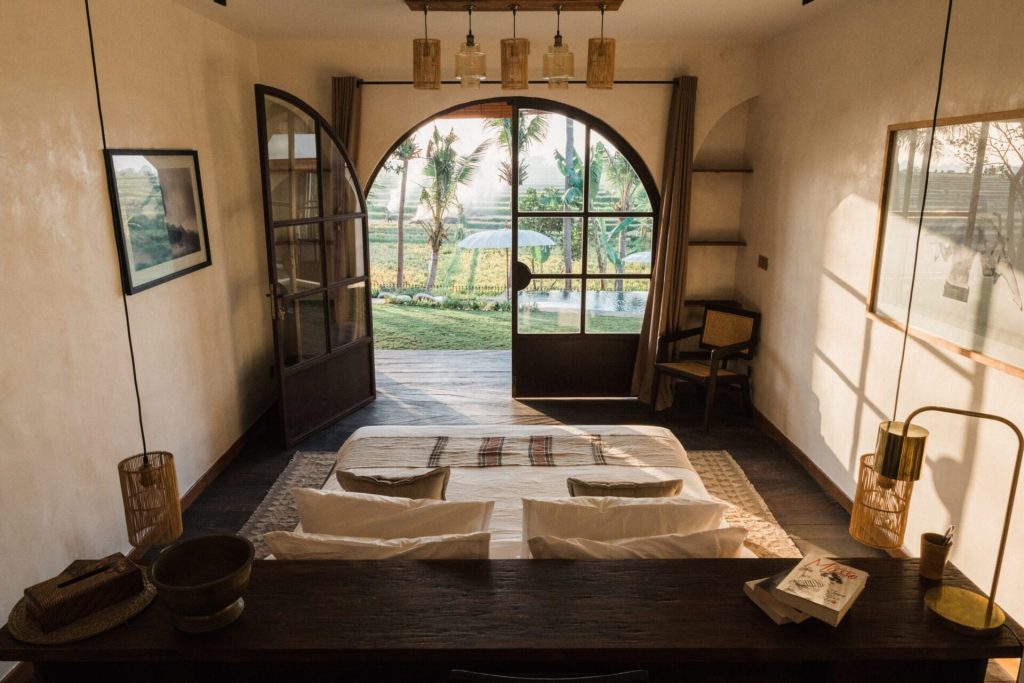
We often bring curves in through the openings. An arch softens the moment you move from one space to the next, and it frames whatever is beyond it: a garden, the sea, the next room. If a house is built mostly in straight lines, this is the easiest place to start.
One curved piece in a straight room
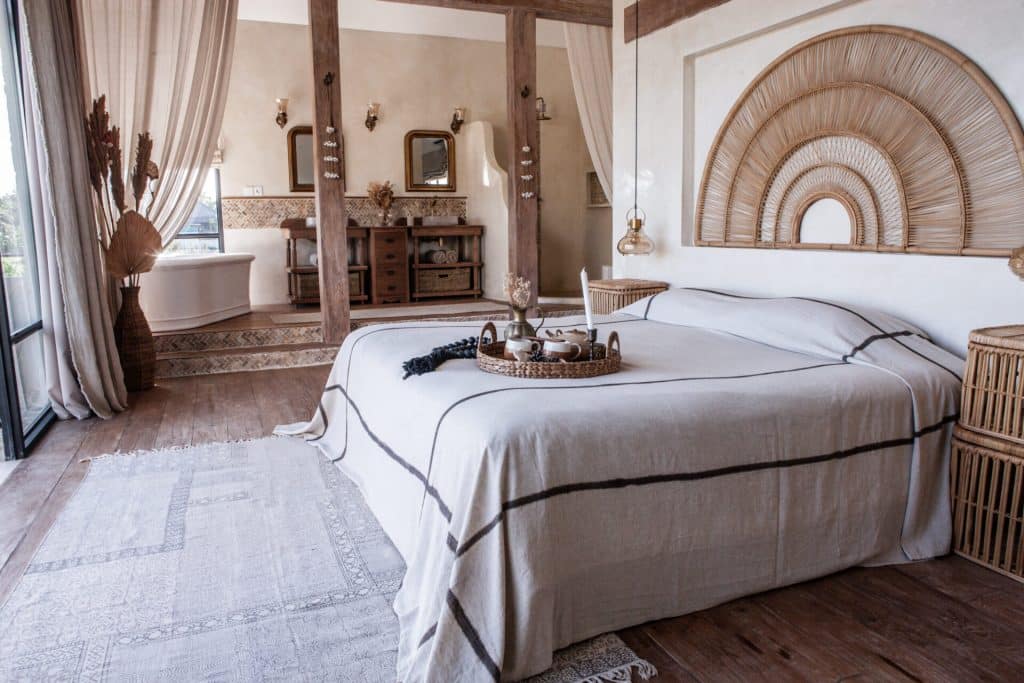
We rarely need to curve a whole room. Often one rounded piece is enough to soften it: a headboard, a mirror, an oval rug or a cluster of round lights. In a bedroom at Villa Kajano, we used a woven half-moon headboard against the straight walls and beams.
Lighting
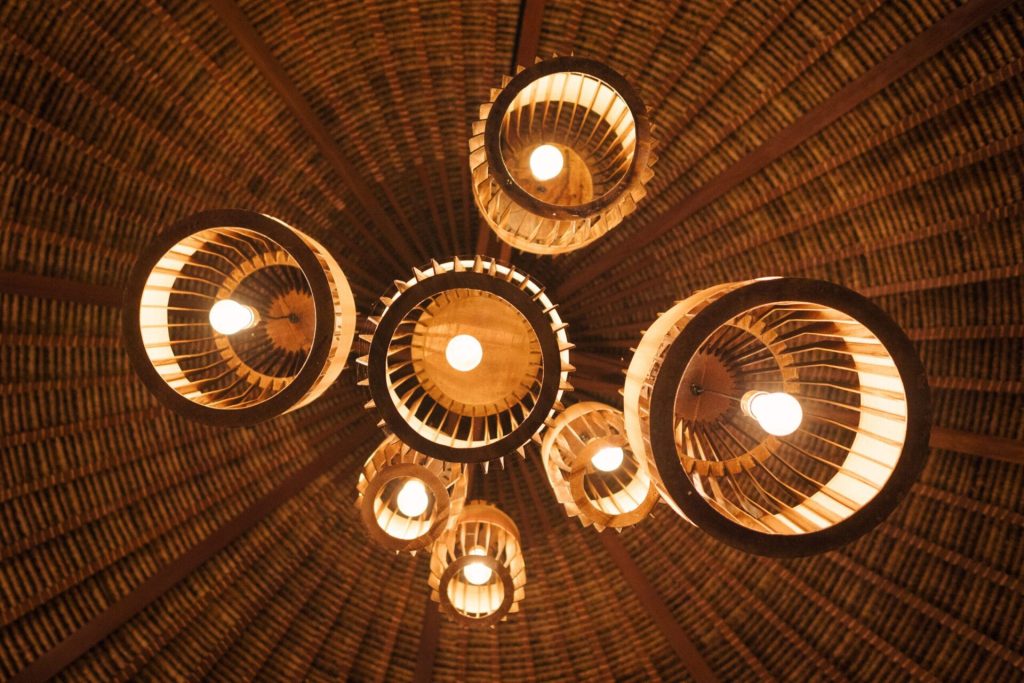
Lights are one of our favourite ways to add curves without touching the architecture. Domed shades, globes and arched floor lamps bring rounded shapes in at eye level and above, and the glow they give is soft-edged too. At Villa Rimba, we hung a cluster of round rattan pendants under the thatched roof.
And where we keep things straight
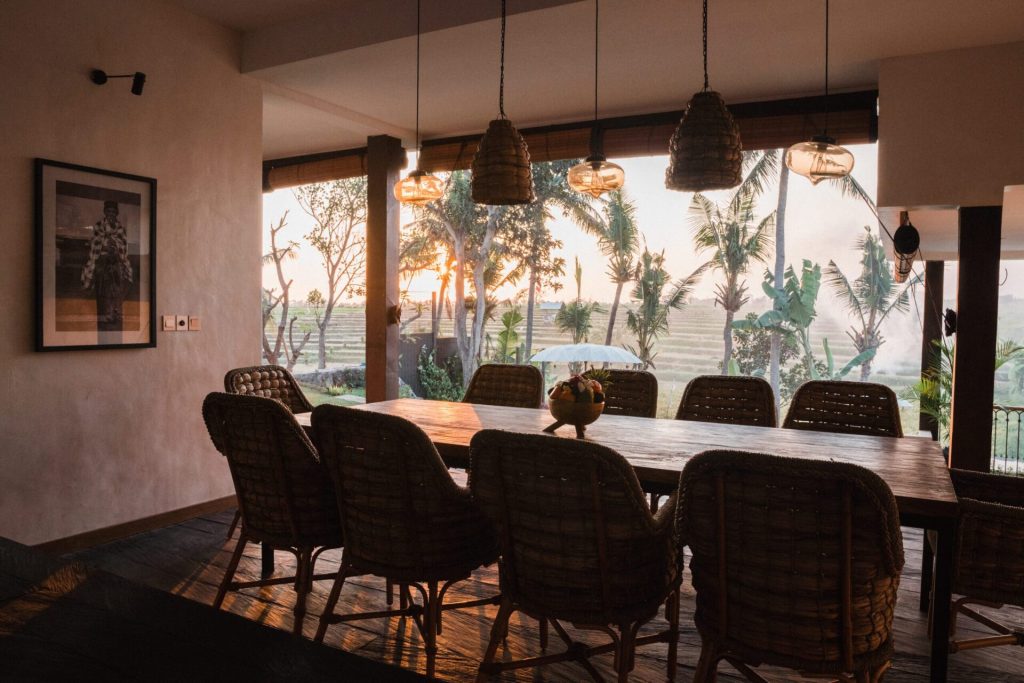
We keep straight edges for the parts of a home that need to work hard: kitchen runs, built-in storage, desks and long dining tables. At Villa Rimba, the dining table is long and straight, and the woven chairs and round pendants around it do the softening. That mix is how we like to approach villa interior design: curves where people gather and rest, straight lines where they work.
Sources
- Bar, M. and Neta, M. (2006). Humans prefer curved visual objects. Psychological Science, 17(8), 645-648. PubMed
- Bar, M. and Neta, M. (2007). Visual elements of subjective preference modulate amygdala activation. Neuropsychologia. Martinos Center, Massachusetts General Hospital
- Gómez-Puerto, G., Munar, E. and Nadal, M. (2016). Preference for curvature: a historical and conceptual framework. Frontiers in Human Neuroscience, 9, 712. Frontiers
- Dazkir, S. S. and Read, M. A. (2012). Furniture forms and their influence on our emotional responses toward interior environments. Environment and Behavior, 44(5), 722-732. Oregon State University
- Vartanian, O. et al. (2013). Impact of contour on aesthetic judgments and approach-avoidance decisions in architecture. Proceedings of the National Academy of Sciences, 110 (Supplement 2), 10446-10453. PubMed