
 " alt="Warm Wood, Soft Light and Natural Textures: Why We Design for Calm">
When we describe an interior as calm, we are considering the relationship between its elements. Timber brings colour and grain. Textiles introduce softer surfaces. Lighting determines which details stand out and which remain in shadow.
At Paz Studio Bali, we look at how those choices come together from different positions within a room. The view from a bed matters as much as the first impression from a doorway.
These photographs of our work offer a closer look at that thinking. They show how material contrast, light and the surrounding landscape can contribute to an inviting interior. Research provides useful context, while our design judgement lies in interpreting those ideas for each space.
Wood gives the room depth and definition
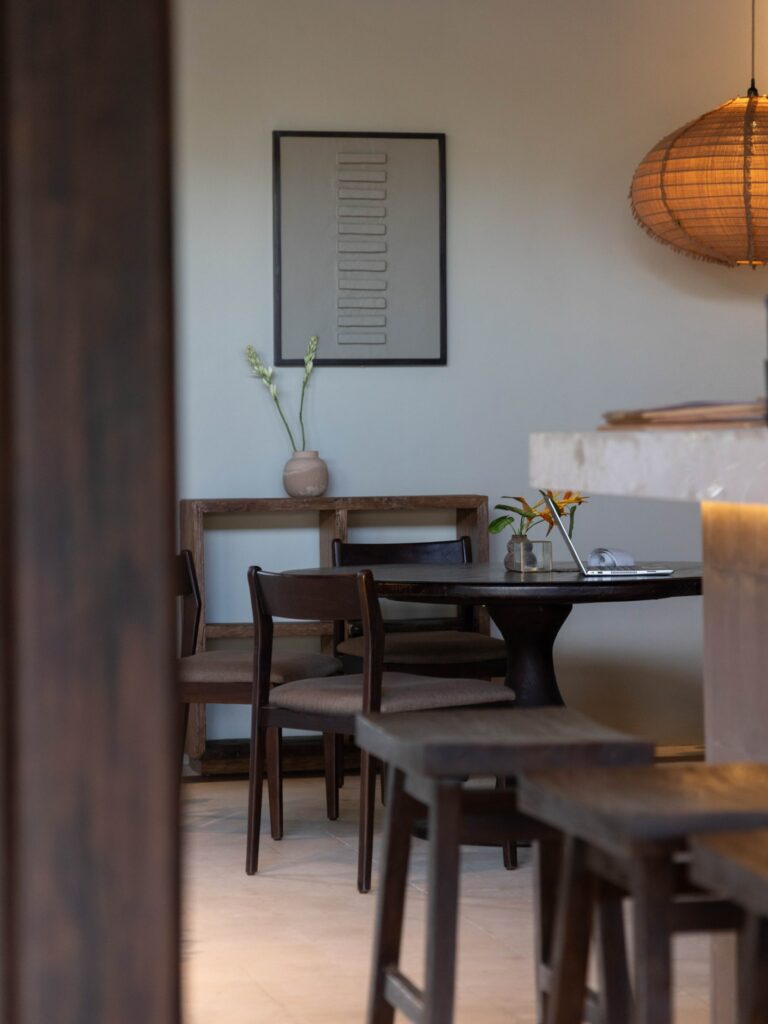
In the dining interior above, the dark table and chairs sit against pale walls and flooring. The contrast makes their forms clear without introducing several competing colours.
The timber console adds another surface with visible grain. Its lighter, less uniform appearance gives variation to the composition, while the neutral seat upholstery connects the furniture to the surrounding room.
We consider the scale of these elements when assessing the balance. A dark dining table occupies a different amount of visual space from a timber wall or ceiling. The room around it needs to be considered alongside the piece itself.
Research suggests that wood can influence how people experience an interior. A 2023 study involving 61 participants compared an office containing wooden elements with a room without wood and reported positive effects on emotional wellbeing in the wooden room.
The physiological results were mixed, including higher sympathetic nervous system activity in the wooden room. We therefore interpret the findings carefully. They support an interest in wood and emotional experience, without establishing that timber automatically reduces stress.
For us, its contribution also comes through the design: the grain, finish, proportions and relationship with neighbouring materials.
Texture creates interest within a restrained palette
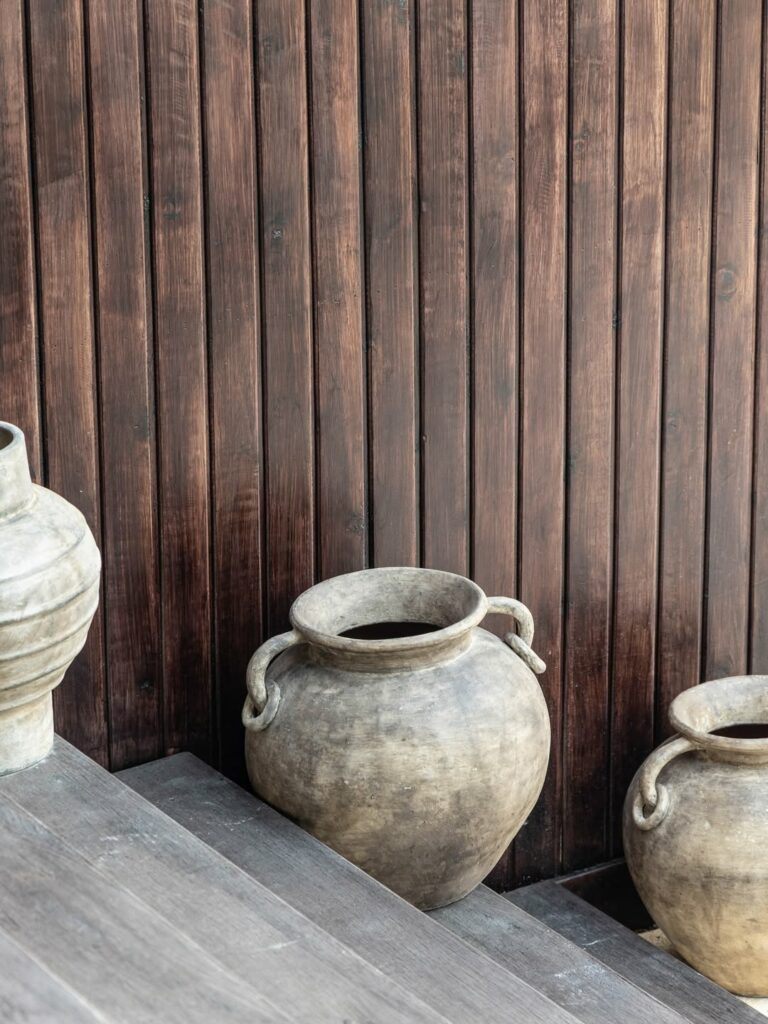
This detail shows how much variation we can achieve with a limited range of colours.
The vertical timber boards establish a repeated pattern. The vessels introduce rounded forms and pale, irregular surfaces. Their shape and texture distinguish them from the background.
We are interested in that relationship between repetition and variation. The boards give the composition structure, while the objects interrupt it at selected points.
Natural texture can contribute detail without requiring a stronger colour accent. We still consider how much detail the space needs. Several pronounced grains, patterns and finishes placed together may compete for attention.
This way of looking at materials also appears in our Amara project story, where timber, woven surfaces and handcrafted objects contribute different qualities to the interior.
Soft light can still serve a practical purpose
Soft lighting does not mean that every part of a room should be dim.
At this desk, the lamp directs light towards the work surface. The surrounding curtains remain quieter, although their folds and weave are still visible. The photograph illustrates how a local light source can give one area a distinct role within the room.
We consider the position of the fitting, where the light falls and whether the source will be comfortable to view from the intended seat. Reading and working need different attention from a space used primarily for resting.
A study in the Journal of Light & Visual Environment compared lighting preferences for imagined social conversation and quiet relaxation alone. Participants preferred brighter conditions for the social activity and lower illumination for the solitary activity.
That distinction is useful to us as designers. A room may accommodate several activities, so its lighting should allow for those changes.
Our article on sculptural lighting and interior atmosphere explores how fittings also contribute form and texture when they are not illuminated.
Daylight brings another layer to the materials
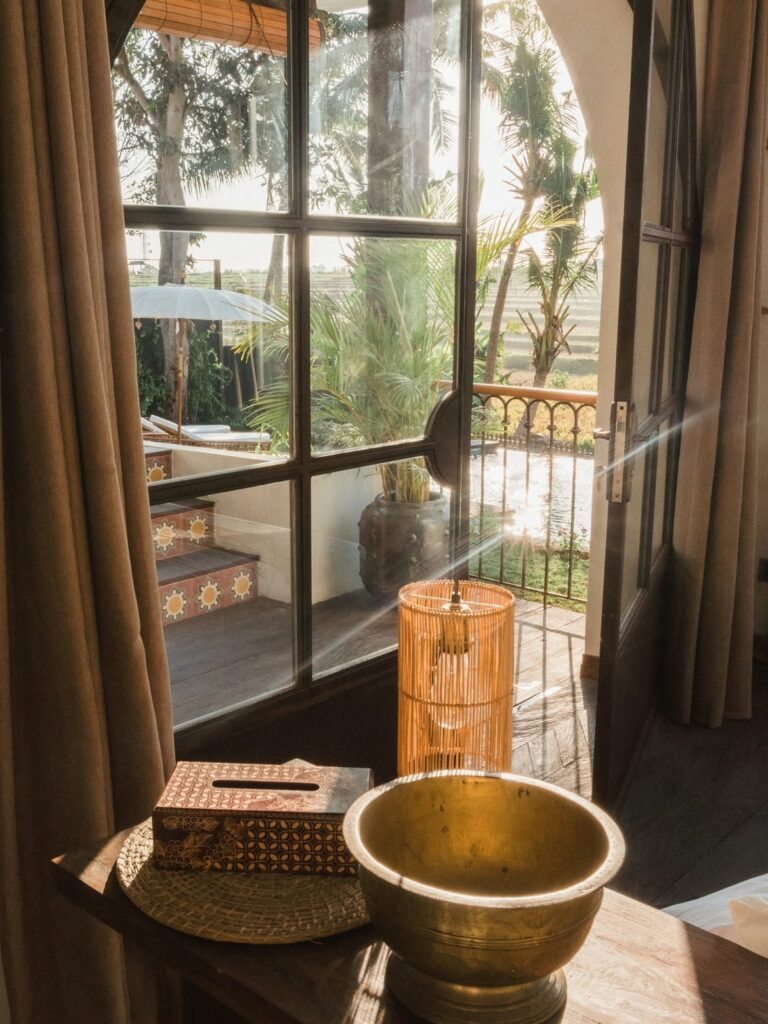
In this detail from Villas Rimba Canggu, daylight falls across the objects beside the glazed doors. The woven tray, timber surface and metallic bowl respond differently.
The bowl catches brighter reflections. The woven surface reveals a finer pattern. The curtains create a softer surrounding background.
We assess these differences when composing a space. A material’s appearance depends partly on the light reaching it, so a sample viewed in isolation cannot tell us everything about the finished interior.
This is also why we consider daylight and evening lighting together. We want the materials to retain a considered relationship as the conditions change.
The landscape becomes part of the interior
From this position, the bedroom extends visually into the landscape.
The pale bedding sits beneath a darker timber foreground. Beyond it, the doors frame greenery and the pool. The surrounding curtains and walls leave that view prominent.
We consider what someone sees while occupying the room. Here, the view from the bed is an important part of the composition.
Research offers context for the interest in natural views. In an experiment involving 40 participants, photographs of natural scenes were viewed longer and rated as more restorative than photographs of built scenes.
That experiment studied images rather than this villa. It does not measure the experience of our guests, but it gives us a useful reason to pay attention to views and the visual connection with planting.
More of the project can be explored in our Villa Rimba portfolio.
Repeated details connect the composition
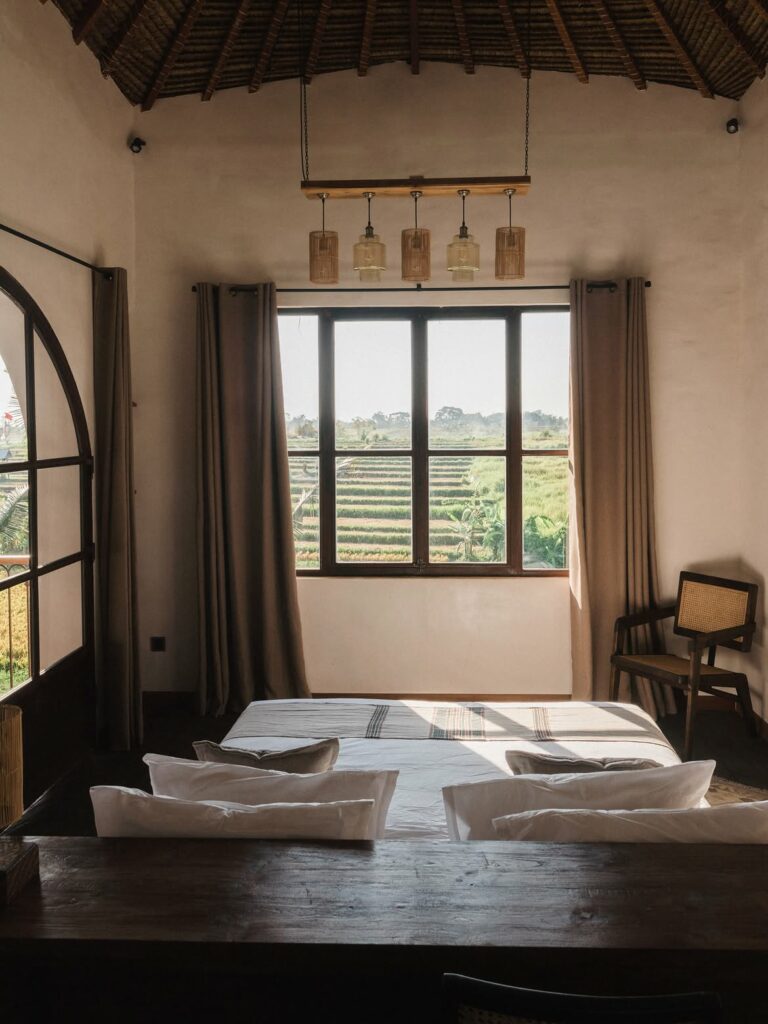
This second bedroom view makes the material relationships easier to see.
Dark timber appears overhead and in the furniture. The chair introduces a woven panel, while the curtains and bedding contribute larger areas of softer texture.
We read these elements together. Repeated timber tones create a relationship across the room, while the pale surfaces keep each darker form visible.
The suspended fittings introduce another detail at a smaller scale. Their arrangement relates to the wider composition without filling every surface with decoration.
When we assess an interior, we look for these connections. A material may return elsewhere in the room, or a colour may be echoed through a textile. The relationship can be subtle.
Our judgement is in how the elements work together
Wood, lighting and natural textures give us several ways to develop an atmosphere. Their effect depends on their placement, scale and relationship with the rest of the space.
We also need to consider how the interior functions. Furniture proportions, circulation and the light needed for daily activities remain part of the design.
The photographs show the questions we examine: how a dark table sits against a pale wall, how a lamp defines a desk, and how a bedroom frames the landscape.
Research helps us interpret aspects of perception and preference. We bring that understanding into the practical work of arranging materials, light and space.
To discuss the atmosphere you would like to create, contact us at [email protected].